
Clinical Information
Evidence-based information for healthcare professionals and patients
Dysphagia
Dysphagia is the medical term to describe a difficulty swallowing solids or liquids. It occurs when nerves, muscles, or structures in the mouth, throat, or oesophagus don't work together properly. Early signs of dysphagia include coughing, gagging or choking when eating or drinking.
Pill dysphagia is when a person has an inability or strong aversion to swallowing medications, often triggered by a pill's shape, size, or a dry throat.
Do you have trouble swallowing pills?
The PILL-5 is a validated 5-item questionnaire that helps identify pill dysphagia. It takes about a minute, and you don’t need to give us any details to see your score.
Take the PILL-5 AssessmentCrushing medications
Crushing tablets isn't always safe. Many medications, including slow-release or enteric-coated tablets, must not be crushed. Doing so can increase the risk of side effects, reduce the therapeutic effect, or result in a loss of dose. Always check with a pharmacist before altering any medication.
Adding foods to medications
Foods have not been designed for use with medications and may impact the efficacy, side-effect profile, and absorption of the drug. Research has shown that mixing crushed tablets into foods and thickened liquids can significantly reduce the rate at which a medication dissolves and becomes available to the body.
Thickened liquids present a particular challenge. For people with dysphagia who are already on thickened fluids, mixing crushed tablets into those fluids can further interfere with drug absorption due to the sticky, thick nature of the gum in thickeners.
Recent research published by the University of Queensland concluded that mixing whole tablets with Gloup® was considered bioequivalent to swallowing whole tablets with water. Clinical evidence available upon request
Foods are ideally intended for nutrition and enjoyment, not for medication administration.

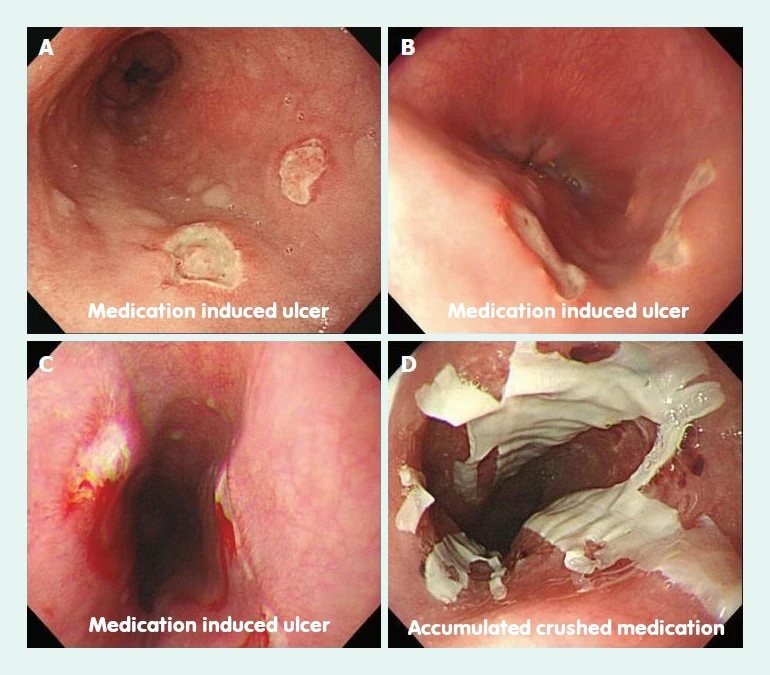
Some foods do not adequately lubricate the digestive tract which may lead to tablets getting stuck and an increased risk of medication-induced oesophagitis. Common medications that can cause drug-induced oesophagitis are: Paracetamol, Antibiotics, NSAIDs (e.g. Aspirin/Ibuprofen), antihypertensives, oral hypoglycaemics (e.g. Metformin) and bisphosphonates (e.g. Fosamax).
Kim SH, Jeong JB, Kim JW, Koh SJ, Kim BG, Lee KL, Chang MS, Im JP, Kang HW, Shin CM. Clinical and endoscopic characteristics of drug-induced esophagitis. World J Gastroenterol 2014; 20(31): 10994–10999 [PMID: 25152603 DOI: 10.3748/wjg.v20.i31.10994]
Gloup® Explainer Video
Semi-recumbent simulation
Gloup® vs Water
Original video fluoroscopy footage: Karen Sheffler — swallowstudy.com
Gloup® vs Apple Puree
Original video fluoroscopy footage: Karen Sheffler — swallowstudy.com
Clinical Papers
Published clinical papers supporting the use of Gloup® to assist with medication administration
-
Does using oral medication lubricants to swallow whole or crushed tablets alter drug absorption in vivo? A randomised, single-dose crossover bioequivalence study in healthy adults
https://www.sciencedirect.com/science/article/pii/S1773224724012218 -
Swallowing safety of oral liquid medications: assessment using the International Dysphagia Diet Standardisation Initiative framework
https://onlinelibrary.wiley.com/doi/full/10.1002/jppr.1818 -
Implementing a medication lubricant for pill dysphagia on an acute care ward using Plan-Do-Study-Act cycles
https://pubmed.ncbi.nlm.nih.gov/38114248/ -
The prevalence and perceived effectiveness of using a medication-swallowing lubricant in aged care facilities across Australia
https://pubmed.ncbi.nlm.nih.gov/37711253/ -
Are Medication Swallowing Lubricants Suitable for Use in Dysphagia? Consistency, Viscosity, Texture, and Application of the International Dysphagia Diet Standardization Initiative (IDDSI) Framework
https://pubmed.ncbi.nlm.nih.gov/32998301/ -
Optimising medicine administration in patients with swallowing difficulties
https://mims.com.au/content/MimsMatters/MMAutumn17.pdf
Other useful links
-
Podcast – Medication intake for people with dysphagia with Kathryn Steadman
https://dysphagiamatters.org/ep-43-medication-intake-for-people-with-dysphagia-with-kathryn-steadman -
Trouble Swallowing Pills? Pill Swallow Gel & Other Resources
https://swallowstudy.com/trouble-swallowing-pills-what-to-do-for-pill-dysphagia/ -
Quantifying Pill Dysphagia – Validation of the PILL-5: A 5-Item Patient Reported Outcome Measure for Pill Dysphagia
https://pubmed.ncbi.nlm.nih.gov/31396520/ -
Clinical and endoscopic characteristics of drug-induced esophagitis
https://pmc.ncbi.nlm.nih.gov/articles/PMC4138480/ -
Crushed Tablets: Does the Administration of Food Vehicles and Thickened Fluids to Aid Medication Swallowing Alter Drug Release?
https://pubmed.ncbi.nlm.nih.gov/24934549/ -
Prevalence of swallowing difficulties and medication modification in customers of community pharmacists
https://onlinelibrary.wiley.com/doi/abs/10.1002/jppr.1052
Downloadable resources
-
PILL-5 Assessment Tool — A validated 5-item screening questionnaire for pill dysphagia (difficulty to swallow tablets)
-
EAT-10: A Swallowing Screening Tool — A validated 10-item screening questionnaire for swallowing difficulty, published by the Nestlé Nutrition Institute
-
How to use Gloup® trolley poster — A4 poster covering whole and crushed tablet use, flavours and thickness levels
-
Tips for Safer Medication Administration (Aged Care Facilities) — Produced in collaboration with Dr Julie Cichero BA, BSpThy(Hons), PhD
-
Supporting children who struggle with swallowing medications — by the Informed SLP